Australia eCommerce Guide for SMBs: Strategic Considerations Before You Launch

Australia eCommerce Guide for SMBs: Strategic Considerations Before You Launch

Navigate the unique challenges of Australian eCommerce. From logistics hurdles to strategic marketing and supply chain stability, learn how to build a resilient, competitive online presence for your SMB.

Arthur Zhang
Arthur Zhang
Co-Founder & Lead Developer

A results-driven developer actively managing and developing architectures, seeking optimized technical solutions to build a vivid, high-performance, and immersive world, by integrating DevOps workflows with scalable architecture.

Since the COVID-19 pandemic, a robust online presence has transitioned from a supplementary luxury to a fundamental requirement within the Australian marketplace. With global heavyweights such as Amazon, Temu, and Shein entrenching themselves in the local market, Aussie consumers are more confident than ever in their ability to shop digitally. This shift has forced a rapid evolution across supporting sectors, including sustainable packaging, logistics, and digital marketing.

For a detailed breakdown of the commercial advantages, please explore our eCommerce Service page.

However, for retailers and entrepreneurs looking to enter the space, several significant barriers to entry exist—some of which are unique to the Australian landscape. While general eCommerce risks are well-documented, the following analysis focuses on the primary logistical and operational challenges we have identified through our project history in physical product distribution.

1. The Logistical Reality: Cost vs. Efficiency

Logistics costs in Australia continue to trend upwards, driven by fuel surcharges and escalating service fees. Even by global standards, the Australian landscape is a high-cost environment for distribution, and consumer satisfaction with local parcel services remains a persistent challenge. For many businesses, identifying a courier that offers a balance of value and consistent performance is often dependent on specific regional infrastructure.

  • For the Retailer: Logistics costs represent a primary threat to profit margins.
  • For the Consumer: Delivery lead times and the convenience of parcel collection are critical factors.

A shopper’s decision to return to a brand is often influenced by this final touchpoint; many may hesitate to purchase again if the delivery process in their specific postcode is unreliable or inconvenient. This logistical friction is exactly why major players like Amazon have invested in proprietary networks like Amazon Flex—to ensure the product's value is not diluted by traditional infrastructure issues.

"In the ultra-competitive parcels market, we need to drive efficiencies as we come face-to-face with global platform players offering low-cost or free delivery." — Paul Graham, CEO of Australia Post.

For SMBs lacking the scale for internalised delivery, the choice of partner is a strategic trade-off. Discount couriers such as Aramex and CouriersPlease may offer superior cost-efficiencies, but they can impact the customer experience depending on the destination. Australia Post remains the "balanced" choice, offering superior tracking and a more accessible network of pick-up points. Currently, even with significant volume discounts, base parcel costs in metropolitan areas typically start at $7.00 per order inclusive of surcharges.

2. Market Transparency and Competitive Pressure

The wealth of information available online serves as a primary motivator for the modern "rational" shopper. The ease of price-matching and cross-referencing reviews has created an environment of intense competition. In a digital context, the seller lacks the advantage of an in-store sales representative to act as an intermediary or negotiator; the customer relies entirely on their own judgment and the data provided.

Furthermore, communicating product value digitally requires significant investment. To remain competitive, SMBs must provide high-fidelity assets—including professional photography, video demonstrations, and even 3D modelling. Businesses that fail to provide clear, transparent data often lose market share to competitors with more robust digital assets.


3. Marketing as a Replacement for Physical Infrastructure

Industry creators often suggest a marketing allocation of 15%–30% of the product price for "lifestyle" categories (e.g., fashion accessories, aromatherapy, or smart devices). While essential goods may require slightly lower margins due to existing demand, the initial return on investment for any startup is typically lower than expected.

A critical barrier for eCommerce startups is that natural traffic does not exist in year one. Unlike a brick-and-mortar store, which benefits from foot traffic, a new online store requires a dedicated strategy to attract visitors. A sophisticated user experience—characterised by stylish design, seamless interaction, and efficient checkouts—is essential, but the marketing cost to drive traffic can often be a shock to the budget.

Our Recommendation: SMBs should budget a first-year marketing spend equivalent to 40% of the cost of a physical retail lease. While substantial, this remains more cost-effective than the overheads associated with a physical fit-out, staffing, and utilities, while offering limitless scalability and accumulated traffic growth.

4. Low Barriers to Entry and Market Saturation

The open nature of the internet allows for rapid entry, yet it also fosters intense competition. The rise of platforms like Shopify has empowered individual "side-hustle" sellers who may not account for the fixed costs required of a formal business entity (e.g., registrations, professional accounting, insurance). For established SMBs, maintaining agility and a clear, professional value proposition is essential to compete with these lower-overhead operators.

Case Study: Ream Page (Paper & Print)

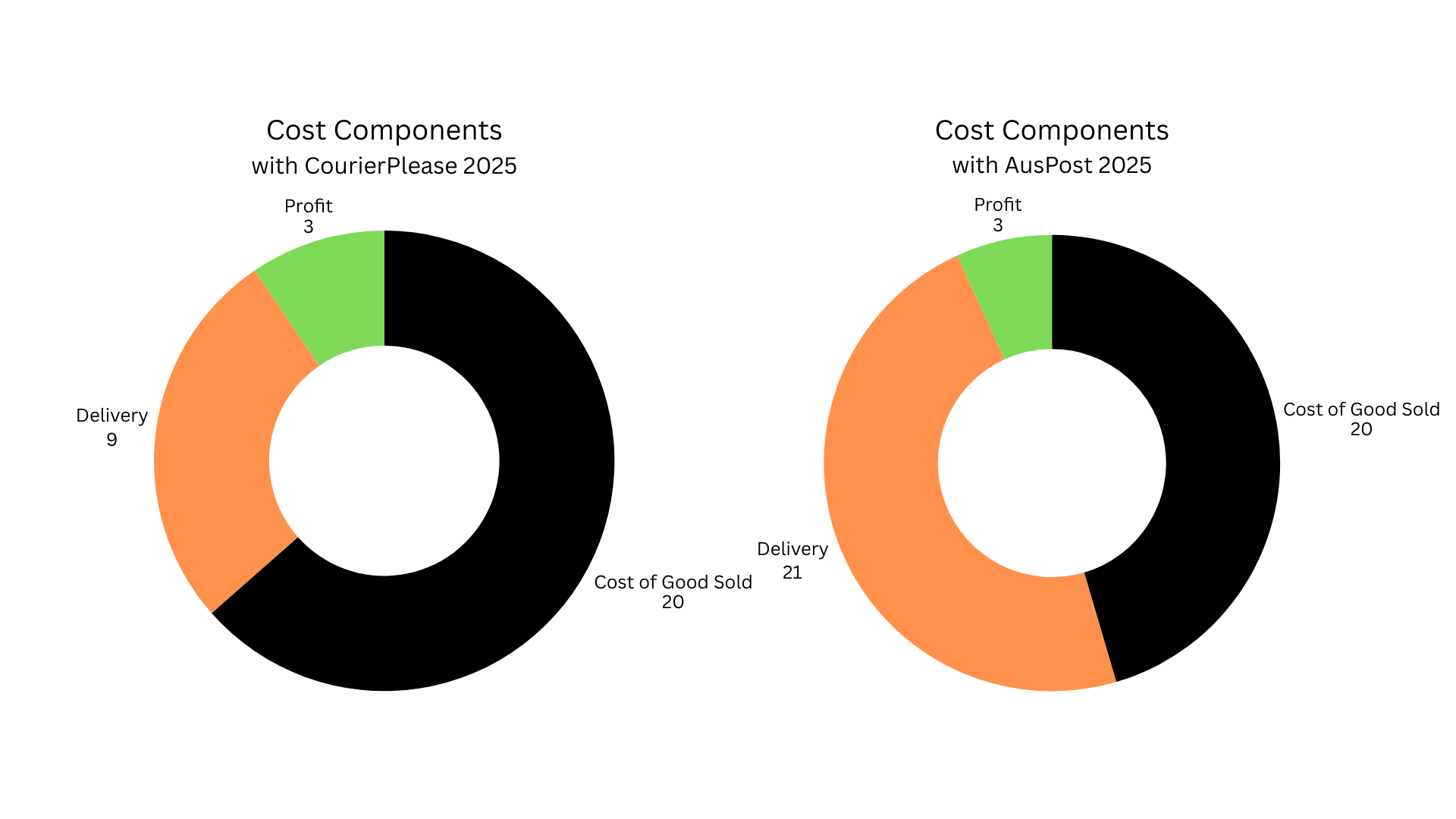
Ream Page is a copy paper wholesaler targeting the Greater Melbourne area. Their primary product is a 13kg carton of A4 paper with a Cost of Goods Sold (COGS) of $20.00.

The Logistics Challenge: Using Australia Post (even with Band 5 highest discounts, except eParcel) incurs a postage cost of approximately $21.00. This makes the product unviable against competitors like Officeworks, who retail similar items for $32.00 with free shipping.

The Solution: By utilising a contracted rate with CouriersPlease ($8.30) and managing internal delivery efficiencies ($5.00), the business stays competitive. Even then, to cover basic labour costs at a 10% margin, they must move approximately 30 tonnes of paper monthly.

Strategic Insights: Beyond the Delivery Cost

This case study reveals a lesson that aligns directly with Item 4 (Competition): a competitor’s "unprofitable" pricing may actually be a calculated strategic move. While paper sales operate on thin margins, the model serves two vital purposes:

Supply Chain Stability: By maintaining their own eCommerce and distribution arm for paper, Ream Page ensures uninterrupted stability and reduced costs for their internal printing department. They are no longer vulnerable to third-party stock-outs or price hikes.

The Hidden Benefit: Competitors often use eCommerce as a "loss leader" to build a market reputation or secure high-volume supply contracts that benefit other, higher-margin parts of their business.

The Lesson for SMBs: You must look beyond the immediate transaction. Your competitor may be gaining benefits from eCommerce—such as data collection, brand authority, or supply chain leverage—that aren't visible on a simple price tag.

How Digibite Can Help

Navigating the Australian eCommerce landscape requires more than just technical execution; it requires a deep understanding of market potentials and business models. Digibite assists entrepreneurs by researching market viability, evaluating operations, and providing digital transformation solutions that accelerate effectiveness while reducing long-term costs.

Have a chat with your eCommerce idea with us

Have a chat with your eCommerce idea with us

Conclusion: Strategy Over Software

Entering the Australian eCommerce market is no longer a simple "plug-and-play" endeavour. While the barriers to entry are lower than ever, the hurdles to long-term sustainability—from navigating our unique logistics landscape to competing in a hyper-transparent market—are significant.

Success belongs to the SMBs that view their online store not just as a sales channel, but as a strategic asset for supply chain stability, brand authority, and scalability. By accounting for these hidden variables before you launch, you ensure that your business isn’t just another URL in the desert, but a robust contender in a thriving digital economy.

Copyright 2026 DigiBite Studio Pty Ltd. All Rights Reserved.
DigiBite Studio supports the LGBTIQ+ community and celebrates diversity.
We acknowledge the Traditional Custodians of the land on which we work and live.